|
John A. Weeks III
Monday, June 8, 2026, 10:33:41 PM CDT |
|||
| Home | Photo Tours | Rail Fan | 12 Easy Steps |
| Aviation | Spacecraft | Highways & Bridges | About The Author |
|
|
|
|||||||||||||||||
Former I-35W Mississippi River Crossing Minneapolis, MN
At 6:05 PM Central Time on Wednesday, August 1, 2007, the I-35W bridge
suffered structural failure and collapsed into the Mississippi River. The
accident happened at the height of rush hour with an estimated 100 cars on
the structure. There were many survivors, but tragically, a number of people
were not so fortunate. As of August 21, 2007, all known victims of the bridge
disaster have been recovered. The toll stands at 13 dead and 144 injured.
The NTSB investigated for 16 months before determining the cause of the
disaster to be a design flaw triggered by several dump-truck loads of sand
and gravel placed on the bridge as part of a repair project.
Note, this page is for the old I-35W Bridge that failed in August, 2007.
For the new I-35W Saint Anthony Falls Bridge, please
click here. For complete coverage of the
bridge disaster, please click here.
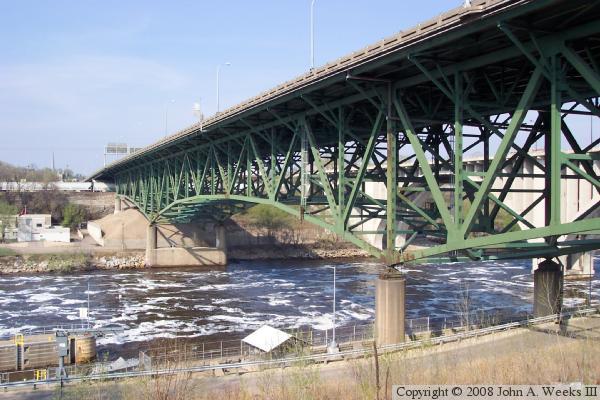
Interstate highways came to the Minneapolis area in the 1960s. The first section of I-35W to be built was the Minnesota River crossing from MN-13 in Burnsville and continuing north through Bloomington. This was planned to be part of a US-65 freeway project, but was converted to Interstate highway when that program was established. This section was completed in 1960. The Crosstown Commons opened in 1963, and south Minneapolis section was completed in 1967. The I-94 commons opened in 1968. The Mississippi River bridge was completed in 1967, but I-35W did not extend across the river until 1971, and then, it ended at University Avenue. The section from University Avenue to the canceled I-335 opened in 1973, the section from I-335 to the present day Quarry shopping center opened in 1975, and the remainder of I-35W to MN-36 opened in 1977. The I-35W bridge was built at a time when technology was king and us Americans could do no wrong. After all, we were going to the moon, so how difficult could some bridge be to build? At the same time, we were building an enormous number of interstate highway miles, so they had to be built fast and inexpensively if we were going to be able to finish the entire highway system. The I-35W bridge suffered from this mentality. There was little oversight in the design, and few considerations for future inspections and maintenance. More critical was the lack of redundancy in the structure. It was built such that if a key structural component failed, the entire bridge could fail. Much was learned about these problems in the aftermath of the Silver Bridge disaster in Ohio, but the I-35W bridge was built about a year too early to benefit from those learnings. The Silver Bridge failed due to a single defect in the steel in one connecting pin that was located in an area that was impossible to inspect. The bridge design is a continuous deck truss. This means that it is a truss structure made up of a lattice of metal beams. A deck truss has the roadway on top of the steel structure rather than under or through the steel lattice. And a continuous truss means that the metal structure spans more than two sets of piers. In this case, there are 4 sets of piers with the truss crossing over three spans. The main Mississippi River span is 458 feet long. The main span was built this way to avoid putting bridge piers into the river, which was now part of the 9-foot navigation channel following the opening the Saint Anthony Falls Locks earlier in the 1960s. While the main span was 458 feet long, the approach spans were 265 feet each, and connector spans of 36 and 40 feet were at the ends of the bridge, for a total truss length of 1,064 feet. The remainder of the bridge was built from steel girders, adding another 843 feet for a total bridge length of 1,907 feet. Once the bridge was finished in 1967, it was opened to local traffic. The traffic deck was marked for 2 lanes of through traffic in each direction. The bridge served as a detour while the fate of the nearby 10th Avenue Bridge was debated. The Interstate highway finally opened in 1971, though it extended only a mile north of the bridge. The I-35W bridge was remodeled three times after it was completed. The first was in 1977, where the deck was milled, and then new concrete was poured on the roadway. The NTSB reports that this increased the dead weight of the bridge by 13%. The second renovation was in 1998. The railings were replaced, allowing 8 lanes of traffic to flow over the bridge. In addition, an anti-ice system was installed. The final renovation was underway in 2007 at the time of the accident. This project was to make a number of repairs, with the major work being removal and replacement of the top two inches of concrete on the roadway. Due to the bridge deck being so thin, this bridge suffered from repeated problems with black ice. MN-DOT installed a spray system to apply an ice melt solution to the bridge surface when icing is possible. This system consisted of 38 valves and 76 spray nozzles. The spray nozzles were installed into holes bored into the deck. They worked much like lawn sprinklers to shoot an antifreeze solution onto the deck across the traffic lanes. This system proved to be so successful that it has been installed on other bridges within the state. The National Bridge Inventory contains a report on this bridge from 2003. It reports the following items:
A University of Minnesota Civil Engineer in a report to MN-DOT recently noted that this bridge is considered to be a non-redundant structure. That is, if any one member fails, the entire bridge can collapse. A key factor is that there are only four pylons holding up the arch. Any damage to any one pylon would be catastrophic. The textbook example of a non-redundant bridge is the Silver Bridge over the Ohio River. It failed shortly before Christmas in 1967 resulting in 46 deaths. A single piece of hardware failed due to a tiny manufacturing defect. But that piece was non-redundant, and the entire bridge collapsed into the icy river. Today, bridge engineers design bridges so that any single piece of the bridge can fail without causing the entire bridge to collapse. It is tragic that the I-35W bridge was built a few years too early to benefit from that lesson. Governor Tim Pawlenty has since ordered inspections all deck truss bridges in the state. There are two similar bridges located in the Twin Cities area, the Highway 23 DeSoto Bridge in Saint Cloud and the MN-243 Bridge over the Saint Croix River in Osceola, Wisconsin. A third deck truss bridge is located on Highway 123 over the Kettle River in Sandstone, MN. The Sauk Rapids Bridge has now been added to the inspection list. The Sauk Rapids Bridge is unique in this list in that it is scheduled to be demolished soon due to a new bridge being built to replace it. In addition, the I-90 Dresbach Bridge over the Mississippi River main channel near La Crosse, Wisconsin, is a non-redundant style bridge that is on MN-DOT's watch list. MN-DOT has an active study to examine alternatives that include removing the Dresbach Bridge, which potentially has many years of remaining life, and replacing it with a bridge that has built-in redundancy. 
The photo above shows the two piers on the south end of the I-35W bridge.
Engineers are focusing on the metal joint just above the pier on the right
side as the location of the failure. Below is a close-up of the southwest
pier of the bridge. Notice the amount of rust. The triangle piece of metal
is the top of the bridge bearing, a device that is supposed to allow the
bridge to slide back and forth as the bridge expands and contracts during
heating and cooling cycles. The bearings had failed on this bridge many
years ago. This prevented the bridge from moving freely, so it had to flex
and bind instead, putting additional loads on the structure.

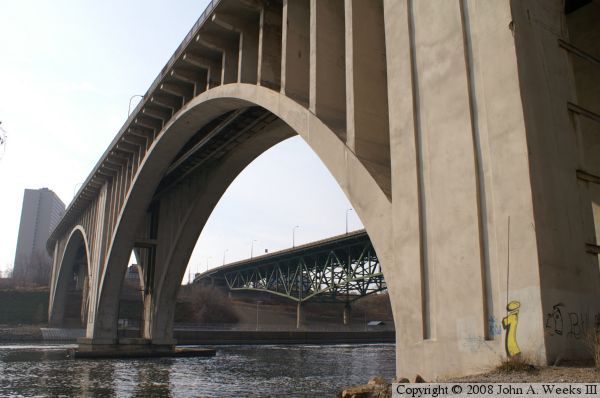
Above, you can see the south end of the I-35W bridge under one of the
main arches of the 10th Avenue Bridge. This
view shows just how close these two structures were. The
bottom picture is the top deck of the I-35W bridge, looking from the
parking lot of the former Hardees burger joint on the north east side
of the bridge. The Metrodome is visible in the background. The
hometown Minnesota Twins had just started a game when the
I-35W bridge collapsed.

|

|
Authored by John A. Weeks III, Copyright © 1996—2016, all rights reserved. For further information, contact: john@johnweeks.com
|