|
John A. Weeks III
Sunday, October 18, 2026, 10:58:05 AM CDT |
|||
| Home | Photo Tours | Rail Fan | 12 Easy Steps |
| Aviation | Spacecraft | Highways & Bridges | About The Author |
|
|
|
|||||||||||||||||
DDA40X — The Centennial Survivors
Railroading out east means a lot of short runs, closely spaced cities,
and relatively flat terrain. The only major obstacles are the Appalachian
Mountains and water crossings. Out west, railroading is a whole different
game. Stops are few and far in between, the grades are miles long, and
the mountains are three times higher. You need serious horsepower, helper
engines, and speed to move cargo across the western plains and Rocky
Mountains.
To meet the challenge, Union Pacific has been searching for the ideal road locomotive for nearly a century. In the 1940's, they had the 4-8-8-4 Big Boy steam locomotives. Their million pound plus tractive pull could meet the challenge, but the high cost of maintenance for steam engines doomed the Big Boy to retirement after only a decade in service. Another attempt at the ideal locomotive was the Big Blow, a gas turbine locomotive. They were very powerful and relatively reliable, but they were also thirsty. The cost of oil doomed the Big Blow to an early retirement. The UPRR badly missed the 8,000 to 10,000 horsepower that the Big Blow could produce. Typical diesel road locomotives of that era were around 2,000 horsepower, so it would take 4 or 5 to make up for the big turbine. In fact, UPRR came up with a specification that they needed 15,000 horsepower at the head of a train, and they wanted it done with only 3 prime movers. General Motors Electromotive Division came up with an earlier idea of joining two 2,500 horsepower GP35 units on a single chassis, resulting in a 5,000 horsepower DD35 unit. There was no room for a cab on the DD35, so the train was pulled by a GP35, two DD35's, and another GP35. That resulted in 15,000 horsepower, but using 4 prime movers. While the DD35 turned out to have reliability problems, the concept itself was proven.
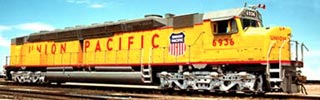
EMD went back to the drawing board, and came up with a new version of the double GP35, powered by pair of GM 645 diesel engines. The 645 had a huge 645 cubic inches of displacement per cylinder. This new locomotive was designated a DDA40X. The D designation means a truck (set of wheels) with 4 axles, the A means a unit with a cab, the 40 was the next good sounding number greater than 35, and the X stood for experimental. The first DDA40X was delivered in May of 1969, which was the 100th anniversary of the golden spike. As a result, the DDA40X was given the nickname Centennial. The Centennial was a winner in road service. They averaged 22,000 miles of use per month, racking up an average of 2-million miles per locomotive by the time they were retired for the first time in 1980. All of the Centennials were put into storage when the railroad economy took a nose dive in the 1979 to 1981 time frame. The Centennials would get a second chance at life when an improving economy in 1984 resulted in the DDA40X being recalled to service. The rail traffic increase started to ease by the end of 1984, and the now elderly Centennials were retired for good. The Centennial was the largest diesel locomotive to go into active railroad service. Largest here means largest diesel in physical size at 98 feet in length. They were also the most powerful diesels at 6600 horsepower until the alternating current revolution saw dramatic power advances on road locomotives in the late 1990's. UP purchased 47 Centennials, of which, 13 survive, 11 in museums, one in a boneyard, and one in active service as part of the UP heritage fleet.
Note—click on the Cab Number to see a photo of each locomotive.
|

|
Authored by John A. Weeks III, Copyright © 1996—2016, all rights reserved. For further information, contact: john@johnweeks.com
|