|
John A. Weeks III
Tuesday, October 13, 2026, 4:47:06 PM CDT |
|||
| Home | Photo Tours | Rail Fan | 12 Easy Steps |
| Aviation | Spacecraft | Highways & Bridges | About The Author |
|
|
|
|||||||||||||||||
B-50 — The Superfortress Survivors
The B-29 Superfortress was a fairly reliable airplane once the large number
of teething bugs were worked out. But one problem that remained is that
the aircraft was underpowered. There were many crashes in the Pacific
where a B-29 simply did not get airborne and ended up crashing at the
end of its take-off run, usually resulting in a big fireball.
Towards the end of WW-II, the larger Pratt & Whitney 4360-35 corncob engine was developed. To test the theory that the B-29 could handle more power, one B-29 was converted to use the new Wasp Major engines. The result was designated XB-44. It was successful, and was subsequently scheduled for production as the B-29D. However, with the end of the war, the B-29 project was being shut down wholesale, as were most other WW-II aircraft projects. To save the B-29D, it was redesignated B-50. Boeing and the USAAF argued that the B-50 was a new design airplane, so it was spared from the axe. 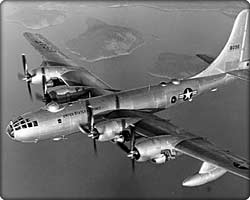

In addition to new engines, the B-50 had a new wing, larger tail, a new
window configuration, and many smaller enhancements. The following table
summarizes the differences between the B-29 and two versions of the B-50.
With WW-II coming to an end before the first B-50 was completed, the B-50 was
recast as a stop-gap strategic nuclear bomber to be used until the B-36 was
ready. The B-50 served this role for 5 to 8 years until the mid-1950's,
working in parallel with the B-36 before being retired as bombers. From
there, many B-50's were converted to training, recon, or weather roles. The
weather planes also flew near the Soviet Union looking for radiation, a
telltale sign that the Russians had tested a nuclear bomb. Other B-50's ended
up as flying tankers for the bomber and fighter fleet. Early tankers used
the hose system, while later versions sported 3 hoses to refuel 3 fighters
at once.
At total of 371 B-50 Superfortresses were built. Some served as late as 1965, being the odd piston airplane on otherwise all jet flight lines. Four complete aircraft still exist, and one relatively complete but disassembled aircraft survives. Despite the success and versatility of the B-50, it is largely a forgotten bomber from a time when aviation was rapidly evolving. In fact, even aviation buffs who see a B-50 in person assume it is a B-29, unless they stop to read the museum guide signs and learn the rest of the story. B-50 Superfortress On Static Display
Note—click on the Serial Number to see a photo of each airplane.
|

|
Authored by John A. Weeks III, Copyright © 1996—2016, all rights reserved. For further information, contact: john@johnweeks.com
|