The Hastings & Dakota already had a line between Minneapolis and Saint Paul. They desired a line around the city to bypass the congestion of the maze of tracks in Minneapolis. The route that they selected ran through Farmington, Prior Lake, Shakopee, and down the south side of the river to Chaska. The route crossed at Chaska on a swing bridge, followed the riverbank for about a mile, then crossed a trestle into the city of Chaska. The line continued west to Cologne.
The original 1871 bridge was an iron swing bridge. It featured the center pin design where the movable bridge section was one single truss span. These bridges were notoriously difficult to keep balanced. The truss sat on a group of rollers that followed a circular track mounted to the top of the center bridge pier. When the bridge needed to be opened, as many as four men would walk to the center of the bridge, and insert bars through the tracks to push on the center pier, causing the bridge to swing open.
The Hastings & Dakota was taken over by the Milwaukee Road shortly after this line opened. The Milwaukee Road pushed west across the state and into South Dakota. In 1905, the Milwaukee Road started building west from Mobridge, South Dakota, and completed their Pacific route to Seattle. Despite having the best route to the Pacific and dominating traffic coming out of Seattle, the Milwaukee Road mismanaged the route and ended up in bankruptcy.
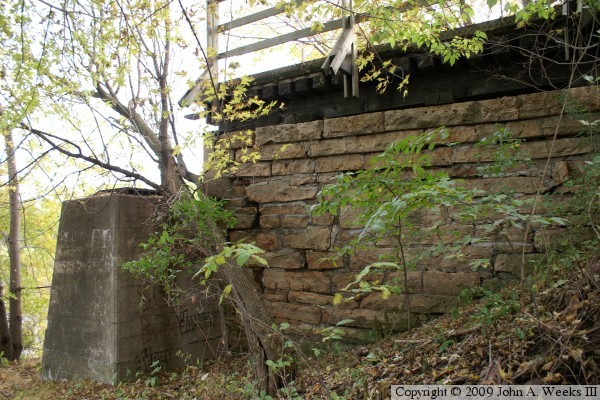
The original iron bridge was obsolete and was replaced in 1900, with the rebuilt rail line opening again in early 1901. A new concrete abutment was built at the north end of the bridge, a Pratt through truss span was installed on the north side of the river, and a pair of Pratt truss spans were joined together to form the swing span. This swing span was also manually operated. The bridge tender would walk to the center of the bridge, insert a crank through the track, and turn a gear on a mechanism located under the track.
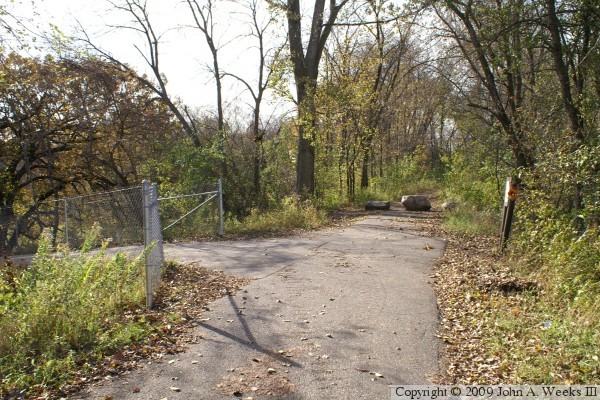
The Milwaukee Road built a connector from Hopkins on the west side of Minneapolis to Cologne, which resulted in the Chaska bridge becoming a secondary route. Traffic dropped off after World War II, and the route through Chaska was abandoned in 1972 after an locomotive derailment damaged a highway bridge over Carver County highway 40. Shortly after the abandonment, the concept of rails to trails was born. The state DNR and the counties of Carver and Scott teamed up to build one of the first rails to trails project in the state. They reclaimed the old Hasting & Dakota line between Chaska and Shakopee and converted it into a paved bicycle and walking path in 1980. Both the bridge and the nearby trestle were redecked and railings were installed. The four mile long path proved to be very successful and helped to prove the concept of rails to trails. The highlight of the trail was the Minnesota River crossing on the old swing bridge.
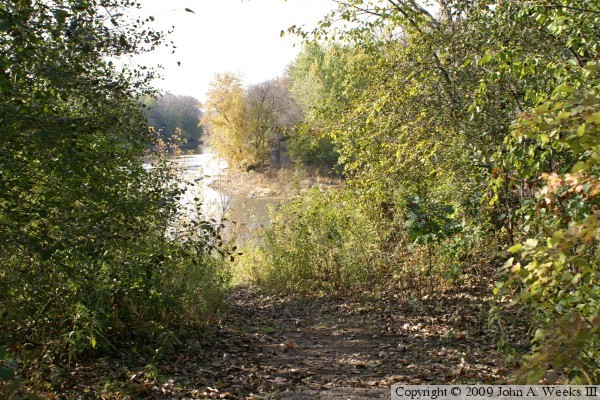
The swing bridge experienced a problem in 1991. It was noticed that the north bridge abutment had shifted 2 inches out of alignment. The abutment was repaired, and the trail was reopened. Then disaster struck the Chaska-Shakopee Bicycle Trail in the late summer of 1996. On August 18, it was noticed that the swing span center pier was leaning. The bridge was closed on August 20, but nearly 300 people climbed the fences and crossed the bridge that day. On August 21, another pier was observed to be leaning. The state DNR inspected the center pier, and found that it was crumbling due to a scour hole that had developed on the upstream side of the pier. This was possibly triggered by a large ice jam that had developed in the river earlier in the year. The DNR determined that the bridge could not be saved, so they engaged a demolition company to bring the bridge down. The Chaska Herald reported that the bridge was leaning 10 degrees towards the west on August 22. Crews worked to attach explosives to the structure on the morning of August 23, and the bridge was blown at 2:25 PM.
At this point, the story gets even worse. Local officials and state representatives were working to obtain funding for a new trail bridge across the Minnesota River at the site of the Chaska Swing Bridge. However, those plans went up in smoke on Halloween night, 1996, when a group of youth accidentally set the Chaska Trestle on fire. By the time the fire was reported and fire crews arrived on scene, the south end of the trestle was almost fully consumed. Fire crews were able to keep the fire off of the northern third of the bridge, but the southern third was damaged beyond repair.
The Chaska-Shakopee Bicycle Trail languished for over a decade. An extension was built south of the river from the old bridge to a landing near MN-41, but there was no way to bring the trail into Chaska. The MN-41 river bridge was too narrow and too busy to allow hikers or bicycle traffic. Finally, a new highway bridge was started in 2004. When finished, it would feature wide sidewalks on each side of the traffic lanes to accommodate regional trail traffic. The new bridge opened in 2007. Once again, this gem of a trail is back in full operation.
Credit goes to railfan and bridge hunter John Marvig for doing much of the research that made this page possible. John located newspaper stories, original photos, and even spoke with people who had photographed the bridge prior to its demise. You can check out these photos on John’s page on the Chaska Swing Bridge.
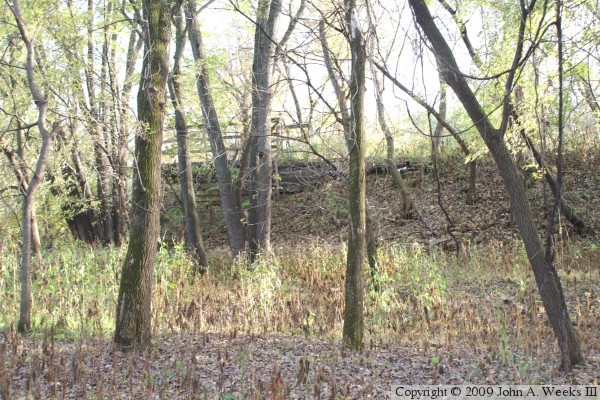
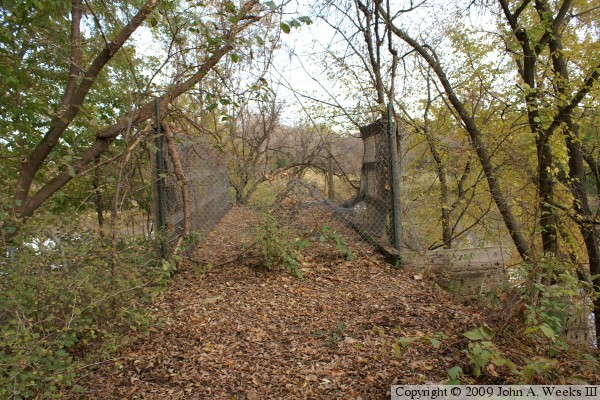
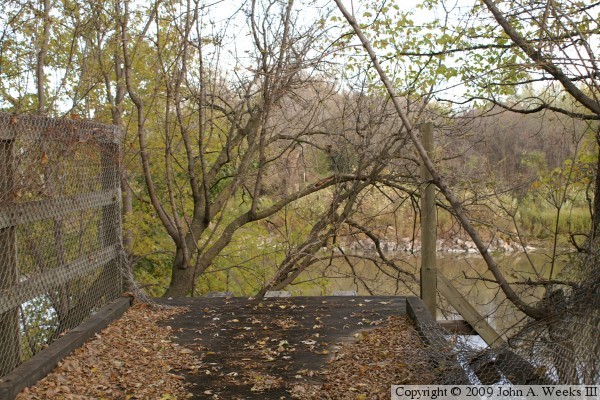
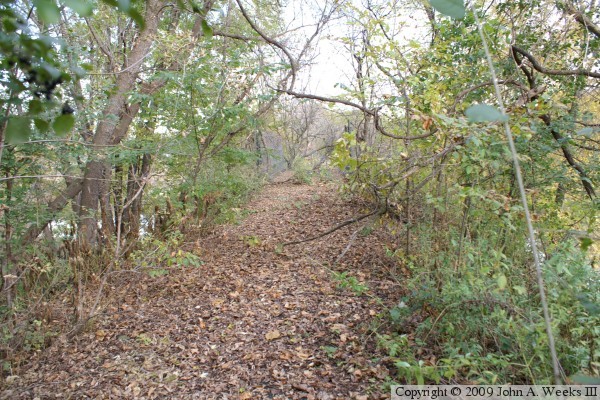
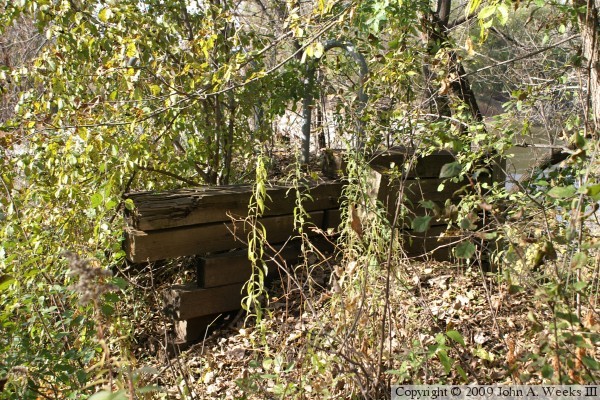
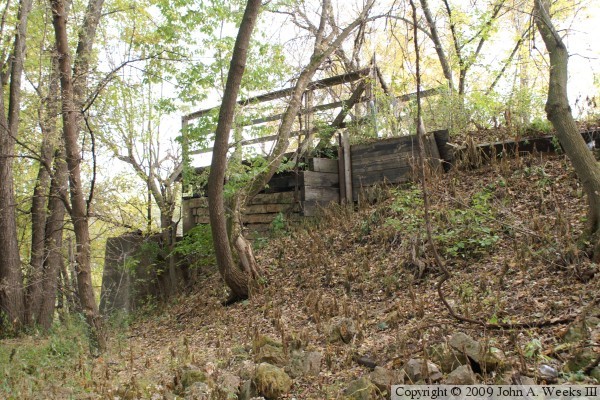
The photo above is looking west towards the remains of the north bridge abutment. The swing span rested on the shorter concrete pier when the bridge was in the closed position. The photo below is a view of the railroad embankment looking through the forest from a nearby access road. The Minnesota river is on the far side of the embankment.